
WhatsApp Chatbot vs WhatsApp Automation: What UAE Businesses Actually Need
A practical UAE business guide to choosing between a WhatsApp chatbot, WhatsApp automation, or a combined workflow for replies, handoff, CRM, and ERP follow-up.
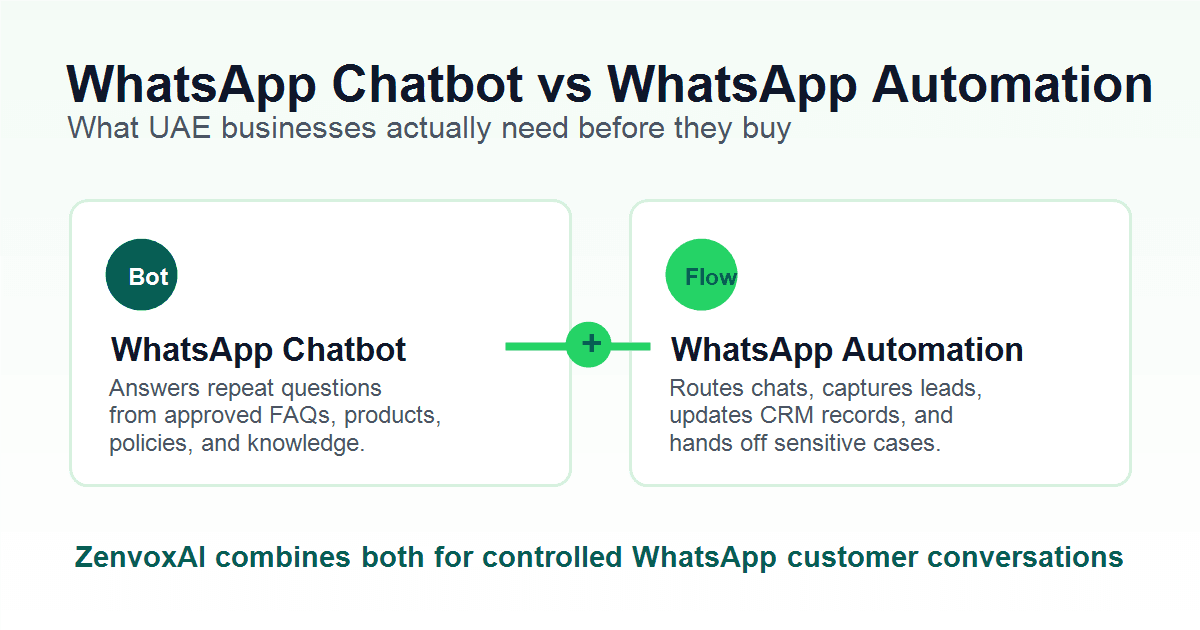
For many UAE businesses, WhatsApp is already the busiest customer channel. Buyers ask for prices, stock, delivery timing, order updates, documents, and support in the same chat window. When a company starts looking for a WhatsApp chatbot or WhatsApp automation, the real question is not which term sounds more advanced. The real question is: what customer work should be answered automatically, and what work should move into a controlled business workflow?
A chatbot and an automation system are related, but they are not the same thing. A chatbot answers questions. Automation moves work forward. ZenvoxAI is designed around both needs because most businesses do not only need replies; they need replies that lead to a proper record, a clear owner, and a next action.
Quick answer: chatbot answers, automation acts
A WhatsApp chatbot is best understood as the answering layer. It reads the customer message, checks approved company information, and replies with a relevant answer. That answer may come from FAQs, product sheets, delivery policies, pricing rules, or service instructions. The chatbot is useful when customers repeatedly ask the same questions and the business wants fast, consistent replies.
WhatsApp automation is the workflow layer. It can route chats, qualify leads, collect missing details, update a CRM, create a task, send a conversation to a human, or attach a summary to an existing customer record. Automation is useful when the message needs more than an answer. It is the difference between saying ?delivery is available tomorrow? and also saving the customer, item, area, and follow-up action.
When a WhatsApp chatbot is enough
A chatbot can be enough when the conversation is simple, repetitive, and low-risk. For example, a retail shop may get the same questions every day: ?Are you open??, ?Where is your branch??, ?Do you deliver to Sharjah??, ?What is your exchange policy??, or ?Do you have this product in black?? If the answers are already approved, a WhatsApp chatbot can reduce response time immediately.
Use case: retail product questions
A UAE retailer can use a chatbot to answer common questions about product categories, store timings, basic delivery rules, returns, and availability guidance. This protects the team from spending half the day repeating the same answers. It also gives after-hours customers a useful first response instead of silence. The key is to keep the chatbot grounded in approved information, not generic internet answers.
Use case: service business FAQs
A clinic, repair service, training center, or home-service company may receive routine WhatsApp questions about booking, documents required, service areas, and pricing ranges. A chatbot can handle these answers quickly and then hand off the conversation when the customer is ready to book or when a special case appears.
When WhatsApp automation becomes necessary
Automation becomes necessary when the business wants the chat to produce an operational result. If a customer asks for a quote, the team may need the customer name, company, location, product, quantity, delivery date, and payment terms. If this stays only inside WhatsApp, the inquiry can be forgotten. With automation, the conversation can become a lead, task, ticket, draft order, or CRM note.
Use case: B2B trading and distribution
Trading companies often receive reorder requests, price checks, and stock questions on WhatsApp. A simple chatbot can answer basic product questions, but automation is needed when the message should become a sales follow-up. ZenvoxAI can support this by connecting WhatsApp conversations with CRM follow-up workflows so the sales team does not need to manually copy every useful detail.
Use case: logistics and freight
A logistics team may receive shipment tracking, ETA, document, and customs questions throughout the day. Some questions can be answered from approved knowledge or connected records. Others need a human because the shipment is delayed, disputed, or sensitive. Automation helps by routing the right chats to operations with the shipment reference and customer context already attached.
Use case: ERP-connected operations
Manufacturing, distribution, and service teams often need WhatsApp to connect with order, stock, delivery, or account data. This is where WhatsApp ERP integration becomes more valuable than a standalone chatbot. The business needs a workflow that checks the right system, prepares the right answer, and records what happened.
The buying mistake to avoid
The common mistake is buying a chatbot when the actual problem is workflow discipline. If the issue is only slow answers, a chatbot may help. If the issue is missed leads, poor handoff, no CRM updates, and scattered customer history, the business needs automation as well. A chatbot without follow-up can still leave the company with messy operations.
The opposite mistake also happens. Some teams jump into complex automation before cleaning up their FAQs, product knowledge, pricing rules, and escalation policies. That creates fragile workflows because the automation has no reliable source of truth. The better path is to start with approved knowledge, then automate the repeatable parts of the conversation.
How ZenvoxAI combines both
ZenvoxAI is built as a controlled WhatsApp customer conversation layer. On the chatbot side, it answers from approved business knowledge in English and Arabic. On the automation side, it supports human handoff, conversation summaries, CRM or ERP follow-up, and structured next actions. The product page explains this combined workflow in more detail.
This matters for UAE SMBs because WhatsApp is not just a support inbox. It is often where sales, service, delivery, complaints, and operations all begin. The product has to respect that reality. The safest approach is not ?automate everything.? The safest approach is to automate what is clear, route what is sensitive, and keep useful records for the team.
A simple decision framework
Choose a WhatsApp chatbot if
Choose a chatbot-first setup if your biggest pain is repeat questions, slow first replies, after-hours silence, or inconsistent FAQ answers. This is usually the right first step for retail, simple services, and teams that want a fast improvement without changing their full operating process.
Choose WhatsApp automation if
Choose automation if your biggest pain is missed follow-up, manual copy-paste, unclear ownership, poor lead tracking, or conversations that should update CRM or ERP records. This is usually the right step for B2B sales, logistics, trading, manufacturing, and any business where WhatsApp messages trigger real operational work.
Choose both if
Choose both if customers ask repeat questions but the answers often lead to quotes, orders, support tickets, delivery checks, or account follow-up. This is the most common situation for UAE businesses using WhatsApp seriously. The chatbot handles the front line. Automation makes sure the business does not lose the outcome.
FAQ
Is WhatsApp automation the same as a WhatsApp chatbot?
No. A chatbot mainly answers questions. WhatsApp automation can include answering, routing, lead capture, CRM updates, reminders, and human handoff. A good customer communication setup often needs both.
Can a WhatsApp chatbot connect to CRM?
Yes, but that is no longer just a basic chatbot use case. Once customer details, summaries, tasks, or leads are saved into a CRM, the business is using a chatbot plus workflow automation.
What should UAE businesses automate first?
Start with high-volume, low-risk conversations: FAQs, store timing, delivery rules, document requirements, basic product questions, and lead qualification. Then add CRM or ERP workflows once the approved knowledge and handoff rules are clear.
Does ZenvoxAI replace the human team?
No. ZenvoxAI is designed to reduce repetitive work and improve response speed while keeping humans involved for sensitive, unclear, or high-value conversations. Businesses can review pricing and setup options based on message volume, team size, and integration needs.
Final recommendation
For most UAE businesses, the right answer is not chatbot versus automation. The right answer is chatbot first for approved answers, automation next for follow-up and records. If your team is already using WhatsApp for sales, support, or operations, start by mapping your top 20 customer questions and the business outcome each one should create. Then use a product like ZenvoxAI to turn that map into a controlled workflow. To discuss your own WhatsApp setup, book a demo and bring a few real customer chats.
Related solutions